T2K
Running Energy range: 0.5–5 GeV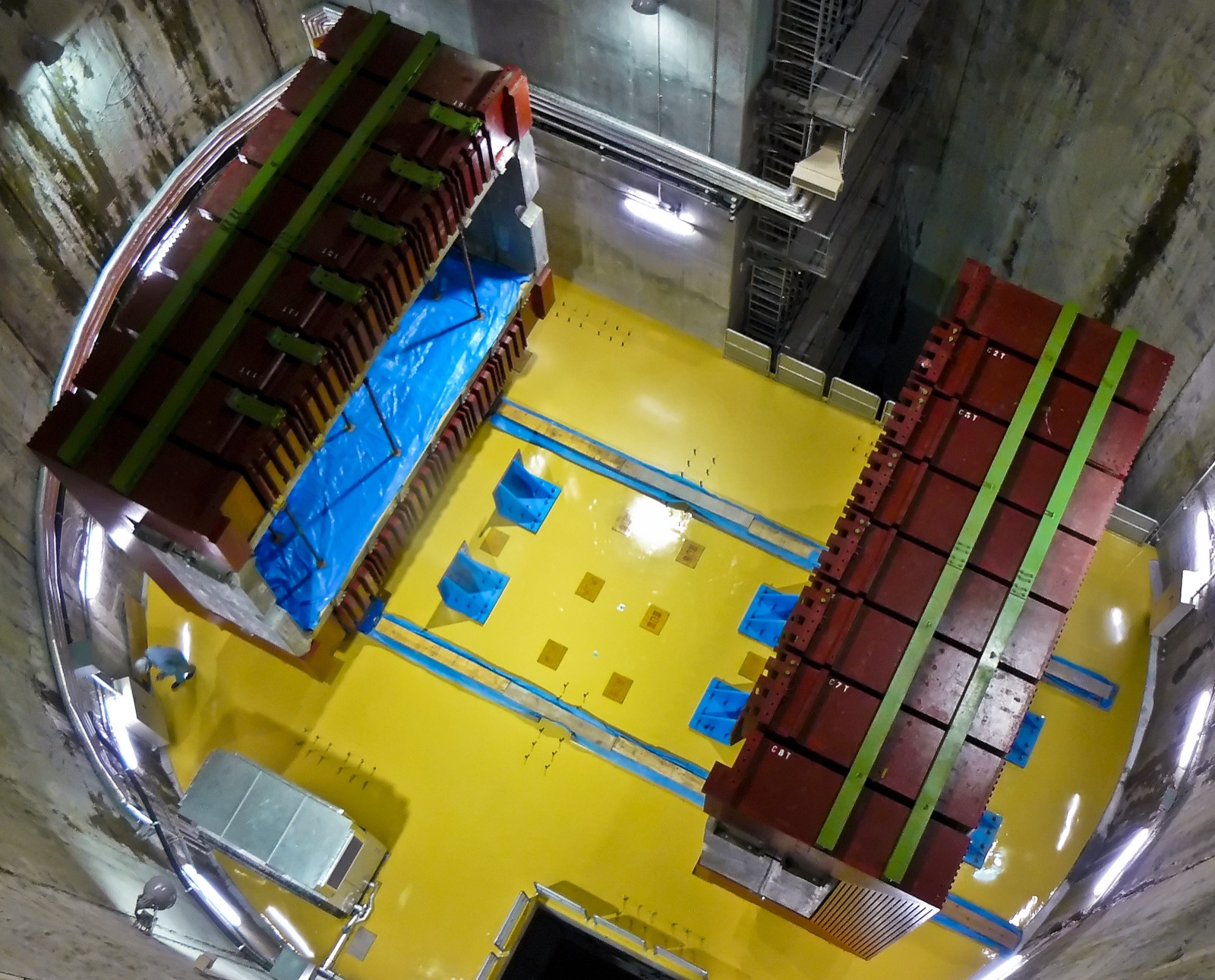
T2K (Tokai-to-Kamioka) is a long-baseline neutrino oscillation experiment in Japan that began data-taking in 2010. It fires a muon neutrino (or antineutrino) beam produced at the J-PARC accelerator complex in Tokai, on Japan’s Pacific coast, toward the Super-Kamiokande detector 295 km away in the Kamioka mine in the Japanese Alps.
The beam is directed 2.5° off-axis, which narrows the neutrino energy spectrum to a narrow peak near 0.6 GeV — close to the first oscillation maximum for the 295 km baseline. T2K uses a suite of near detectors on the J-PARC site, most notably ND280, a magnetized off-axis tracker containing time projection chambers (TPCs), fine-grained scintillator detectors, and electromagnetic calorimeters, to characterize the beam and neutrino interactions before oscillation. The far detector, Super-Kamiokande, is a 50,000-tonne water Cherenkov detector that identifies electron and muon neutrino interactions by the ring patterns of Cherenkov light.
T2K’s key achievements include the first observation of νμ → νe appearance (2013), precise measurements of νμ disappearance, and the first indications of CP violation in the neutrino sector. It also made important measurements of neutrino cross sections and nuclear effects on neutrino interactions.
T2K open data releases include fit outputs, histograms, and ROOT files hosted on Zenodo, together with ROOT macros for plot extraction and result validation. In 2025, T2K and NOvA combined their likelihood information in the first joint Bayesian oscillation analysis, sharing parameterized likelihood functions, systematic uncertainty models, and near-detector constraints, implemented via containerized likelihoods using the ARIA and MaCh3 frameworks.