Daya Bay
Completed Energy range: 2–8 MeV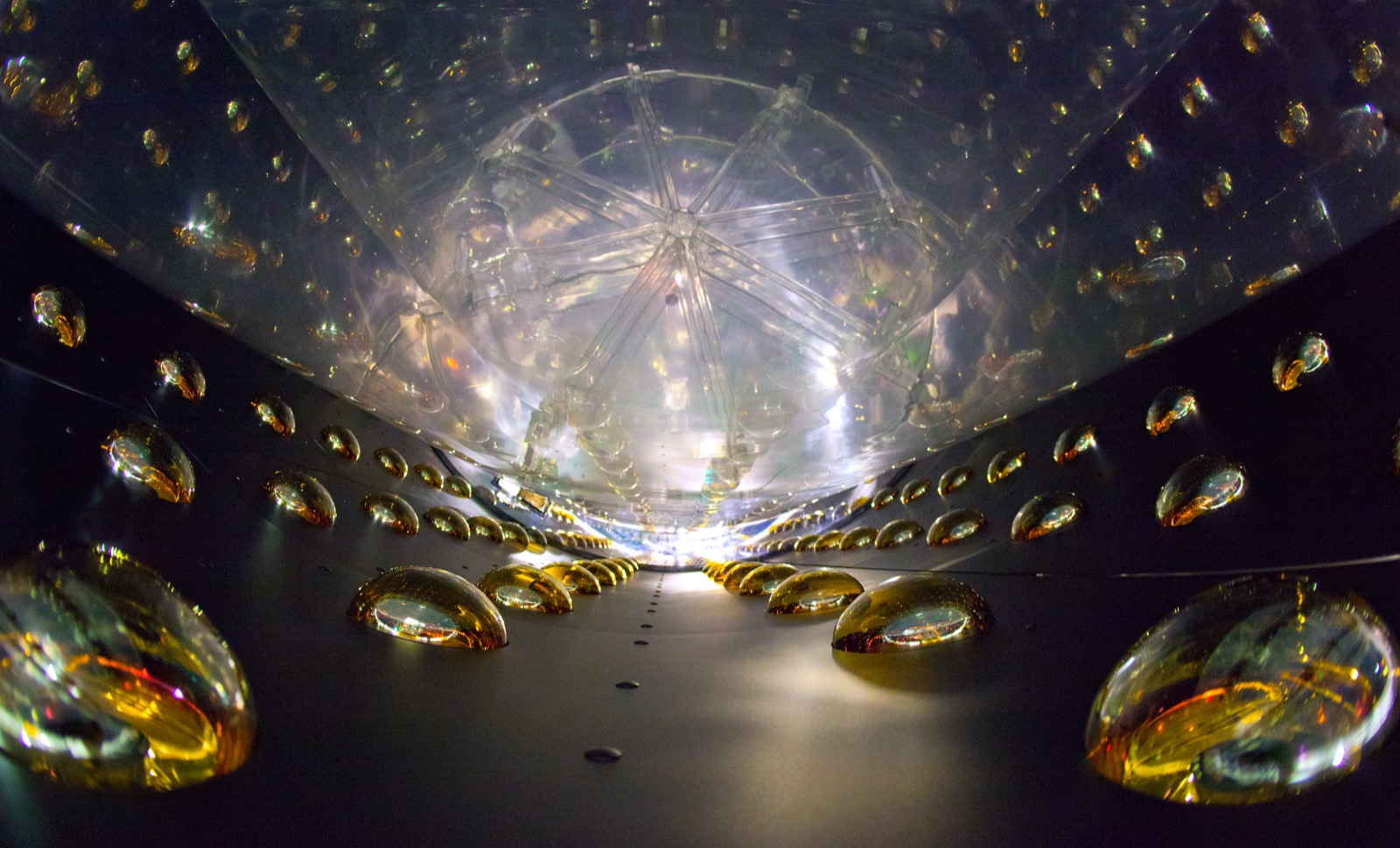
Daya Bay was a reactor antineutrino experiment located near the Daya Bay and Ling Ao nuclear power plants in Guangdong, southern China. It operated from 2011 to 2020 and made the world’s most precise measurement of the neutrino mixing angle θ₁₃, announcing its discovery in March 2012.
The experiment deployed eight functionally identical cylindrical antineutrino detectors — each containing 20 tonnes of gadolinium-doped liquid scintillator surrounded by mineral oil and a layer of undoped liquid scintillator — at three underground experimental halls: two near halls close to the reactor cores and one far hall at ~1.6–1.9 km baseline. Antineutrinos were detected via inverse beta decay (IBD): ν̄e + p → e⁺ + n, producing a coincident signal of a prompt positron annihilation followed by neutron capture on gadolinium. The gadolinium doping provided a distinctive ~8 MeV gamma cascade that suppressed backgrounds.
Over its full data-taking period of 3158 days, Daya Bay recorded 5.55 million nGd IBD events — the largest reactor neutrino dataset ever collected. The experiment measured sin²(2θ₁₃) = 0.0851 ± 0.0024, resolving a long-standing ambiguity in the neutrino mixing matrix and establishing the viability of reactor-based searches for the CP violation phase δCP.
The complete Daya Bay open dataset (2011–2020) is released on Zenodo and includes tabular event data in HDF5, NPZ, and ROOT formats, metadata, and an analysis dataset containing IBD candidates together with all inputs needed for oscillation fits. A Python analysis package (dayabay-model) and fit scripts are available on GitHub.