MINERvA
Completed Energy range: 1–10 GeV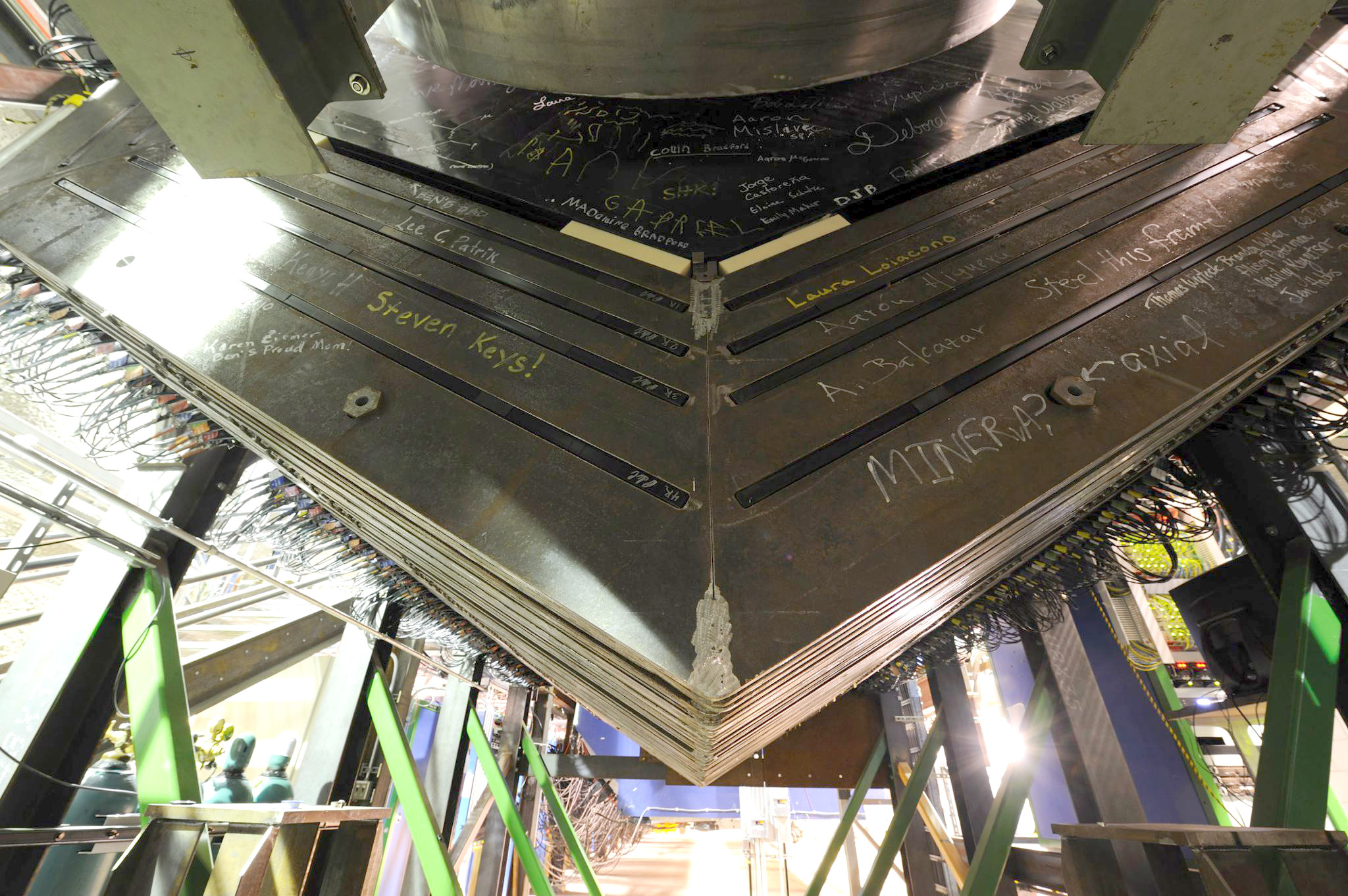
MINERvA (Main Injector Experiment for ν-A) was a neutrino cross-section experiment at Fermilab that ran from 2009 to 2019. It used the NuMI (Neutrinos at the Main Injector) beam and studied neutrino and antineutrino interactions in the ~1–10 GeV range across two beam configurations: a low-energy (LE) run and a medium-energy (ME) run.
The detector was a fully active fine-grained scintillator tracker composed of triangular plastic scintillator strips arranged in X, U, and V planes, giving three-dimensional track reconstruction. Surrounding the active tracker were several nuclear target regions containing carbon, iron, lead, water, and helium, allowing direct comparisons of neutrino interactions on different nuclei. Downstream of the tracker sat an electromagnetic and hadronic calorimeter, and the MINOS near detector served as a muon spectrometer.
MINERvA’s primary scientific goals were precise measurements of neutrino and antineutrino cross sections — quantities needed to reduce systematic uncertainties in long-baseline oscillation experiments such as NOvA and T2K — as well as studies of nuclear effects and quark-hadron duality.
The MINERvA open data release provides analysis-level event samples: pre-selected νμ and νe charged-current candidate events together with corresponding simulated data, reconstructed variables used directly in physics analyses, and full systematic uncertainties covering flux, interaction model, and detector response. The release is accompanied by the MINERvA Analysis Toolkit (MAT) software for event reading, plotting, and systematic weighting, enabling cross-section measurements and reinterpretation of published results with improved models.