NOvA
Running Energy range: 0.5–5 GeV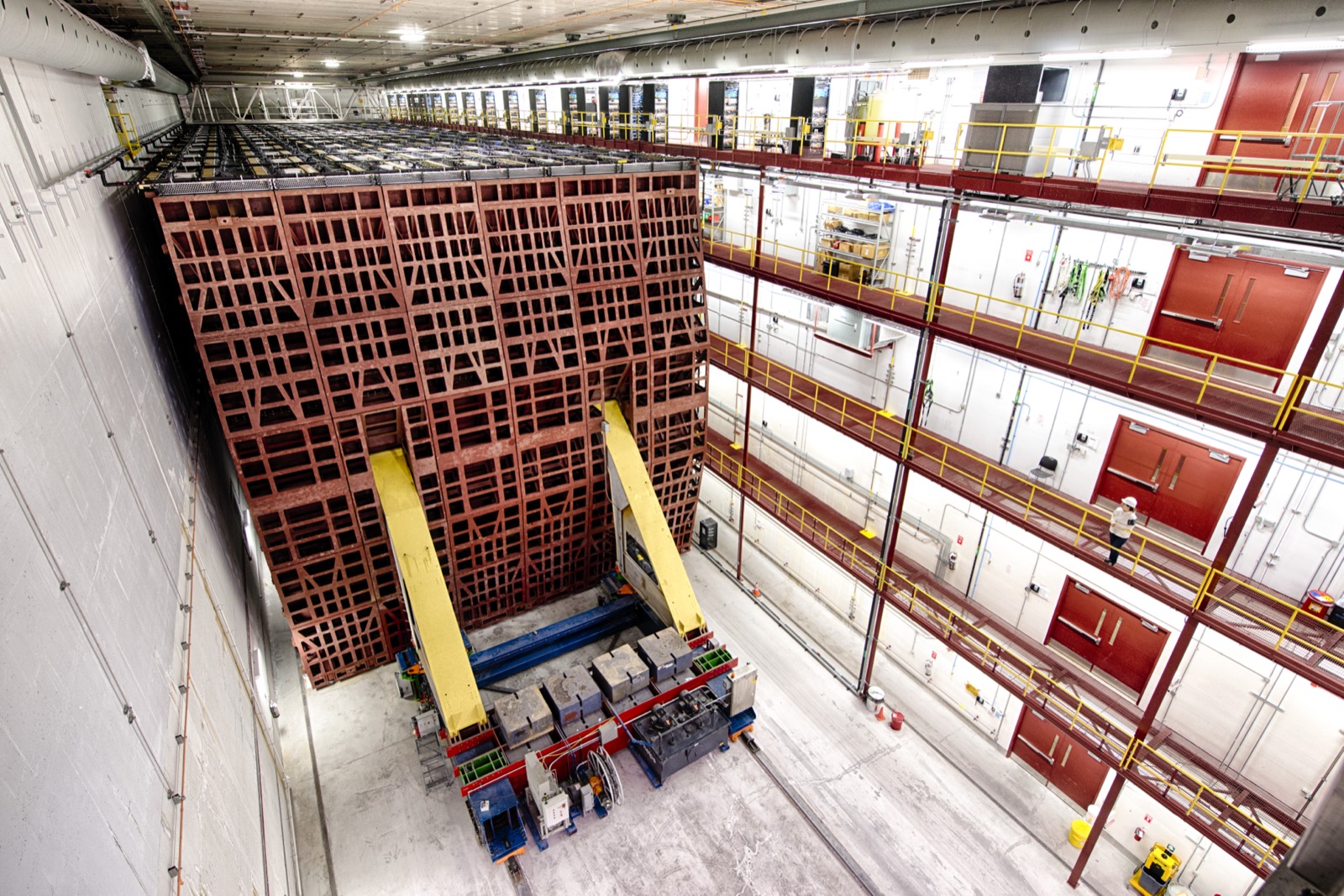
NOvA (NuMI Off-Axis νe Appearance) is a long-baseline neutrino oscillation experiment at Fermilab that has been taking data since 2014. It uses the NuMI (Neutrinos at the Main Injector) beam, which travels 810 km from Fermilab in Batavia, Illinois to the NOvA Far Detector at Ash River in northern Minnesota — the longest baseline of any accelerator-based neutrino oscillation experiment currently in operation in the US.
Both the near detector (at Fermilab) and far detector (at Ash River) are functionally identical tracking calorimeters built from extruded PVC modules filled with liquid scintillator. The far detector, which weighs 14,000 tonnes and stands above ground, is one of the largest plastic-based particle detectors ever constructed. The detectors sit 14 milliradians off the NuMI beam axis, which narrows the neutrino energy spectrum to a peak around 2 GeV and enhances sensitivity to electron neutrino appearance — the signal for νμ → νe oscillations.
NOvA’s primary physics goals are measurements of the neutrino mass ordering, the CP violation phase δCP, and the atmospheric mixing parameters θ₂₃ and Δm²₃₂. In 2025 NOvA and T2K performed the first joint Bayesian oscillation analysis, combining their likelihood information — including parameterized likelihood functions, systematic uncertainty models, and near-detector constraints — to achieve improved precision on Δm²₃₂ and stronger constraints on δCP.
NOvA open data releases provide histograms, tables, and ROOT files from published oscillation and cross-section analyses, hosted on Fermilab public document servers.