IceCube Neutrino Observatory
Running Energy range: GeV–PeV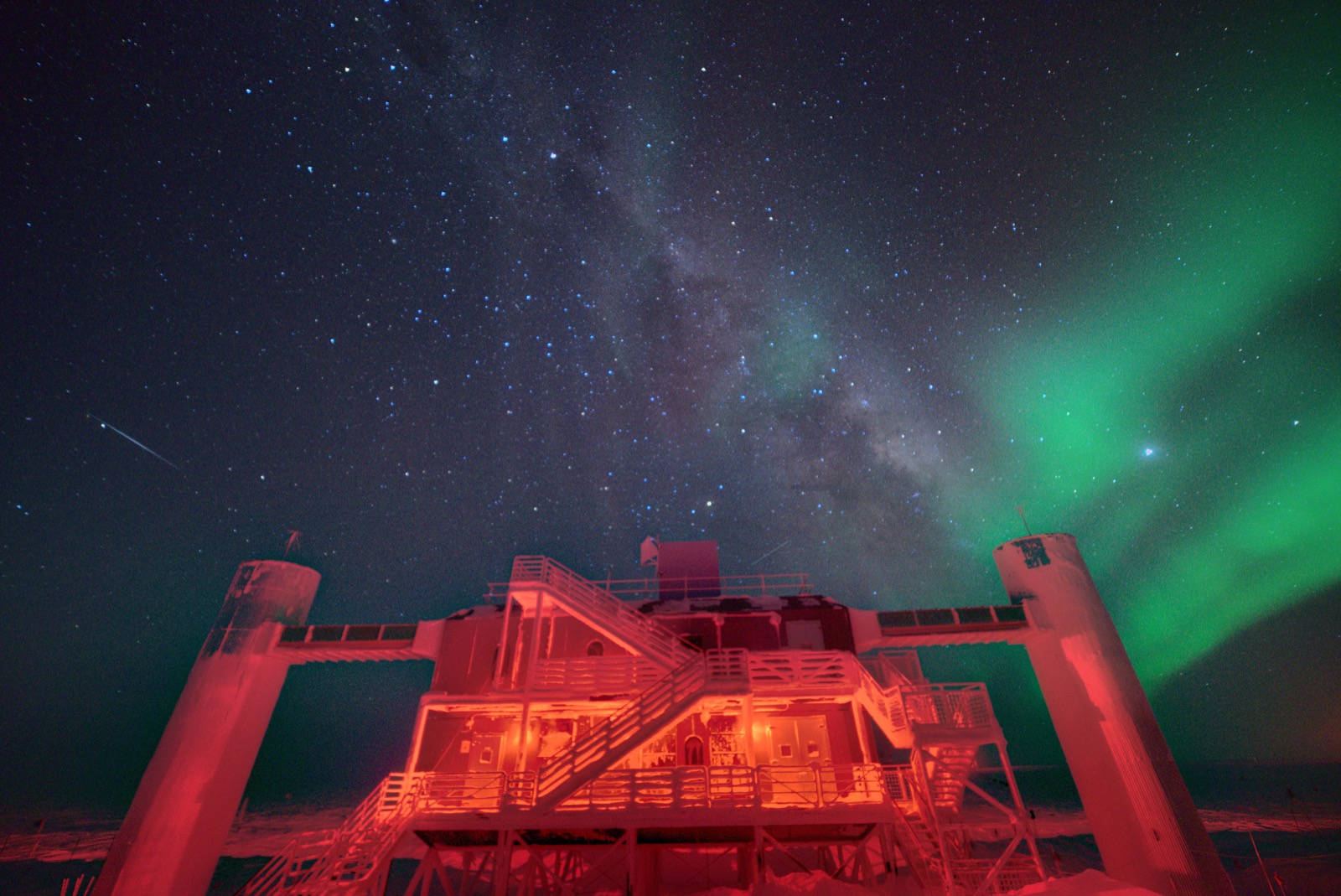
IceCube is a cubic-kilometer neutrino observatory buried deep in the glacial ice at the geographic South Pole, Antarctica. Construction was completed in December 2010 and the detector has been operating continuously since then, making it the world’s largest neutrino detector.
The detector consists of 5160 digital optical modules (DOMs) — each containing a photomultiplier tube and readout electronics — deployed on 86 vertical strings between 1450 m and 2450 m depth in the ice. When a high-energy neutrino interacts in or near the instrumented volume, it produces secondary charged particles that emit Cherenkov light as they travel through the ice faster than light travels in that medium. The DOMs record the arrival time and charge of the Cherenkov photons, allowing the energy, direction, and flavor of the original neutrino to be reconstructed. A surface air shower array (IceTop) sits above the in-ice detector and serves as a veto and cosmic-ray calibration tool. A denser inner subarray (DeepCore) lowers the energy threshold to a few GeV for atmospheric neutrino oscillation studies.
IceCube’s primary discovery — announced in 2013 — was the first detection of a high-energy astrophysical neutrino flux with energies from ~100 TeV to several PeV, opening the era of high-energy neutrino astronomy. Subsequent analyses have identified point sources, correlated neutrinos with blazar TXS 0506+056 and the Seyfert galaxy NGC 1068, and contributed to multi-messenger astronomy campaigns.
IceCube makes regular public data releases covering event-level data (photon arrival times, charges, and positions) in HDF5 and CSV formats, event catalogs, and analysis-level datasets for specific published results. Tools and documentation are provided on the IceCube data releases page.